Range Repair
BlueStar Range vs Wolf: Burners, Ovens and What Breaks
Choose a BlueStar range for open burners with big heat, simple mostly mechanical controls and wide color choice; choose Wolf for sealed burners that simmer very low, electronic oven modes and an easier wipe-down. Here is how the two compare on build, cooking, faults and service.
6 min read Declan Moriarty, Refrigeration technician — sealed systems and airflow · 21 years in the trade
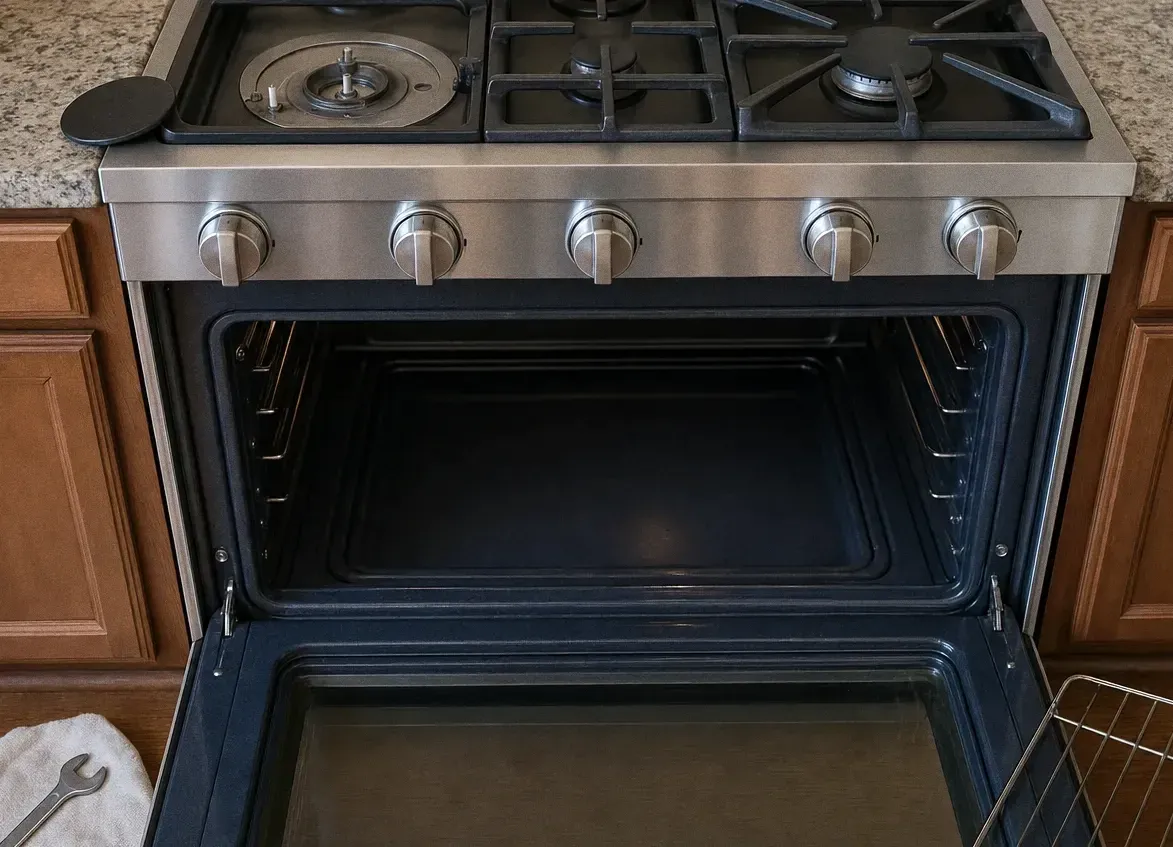
Pick a BlueStar range if you want open burners with serious heat, controls that are mostly knobs and valves, and a finish in almost any color. Pick Wolf if you want sealed burners that can hold a whisper-low simmer, more oven modes and a cooktop that wipes clean in a minute. The numbers show the split: the 36-inch BlueStar RNB366BV2 runs 22,000 BTU UltraNova open burners, while the strongest burner on a Wolf dual fuel range, the front left, is rated 20,000 Btu. Neither one is the better range for every cook. The right choice depends on how you cook, how you clean, and how much electronics you want between you and the flame.
We repair both brands, so this comparison comes from what we find once the grates are off and the panels are open, not from a showroom floor.
Burners: open star heads or sealed, stacked rings
Most BlueStar ranges use open burners. On the RNB and RCS lines the burner is a star-shaped head sitting over an open well with no sealed pan around it, so the flame fans out wide and a wok or a big sauté pan gets heat right out to its rim. The RNB366BV2 pairs its 22,000 BTU burners with a 1,300 BTU simmer burner. The RCS366BV2 uses 15,000 BTU open burners plus a simmer burner rated at 1,300 BTUs that holds roughly 130°. The cost of all that openness is cleanup: a boil-over drops through to a tray underneath, which you slide out and wash.
Not every BlueStar is open, though. The Platinum line, including the 36-inch BSPGR366B, uses X-8 sealed burners rated 25,000 BTUs at the front and 18,000 at the back, and each one turns down to a 500 BTU warm setting. RCS is also sold in a sealed burner version at 24, 30 and 36 inches, alongside the open burner RCS at 30 and 36 inches.
Current Wolf gas and dual fuel ranges use sealed burners. On a dual fuel model the front left burner carries 20,000 Btu, the other front burners 18,000, the rear left 9,200 and the remaining rear burners 15,000. Each Wolf burner stacks two flame rings, so the lower tier can keep a sauce barely moving while the upper tier does the searing. Spills stay up on the cooktop instead of falling into a tray, which makes the daily wipe quicker, but a cap nudged out of place during cleaning is one of the most common reasons we see a lopsided flame or a burner that clicks and never catches.
An older Wolf may not be sealed at all. You are looking at the earlier R Series if every burner is open under its own grate and the oven light works from a black toggle; a GR shares each grate between a pair of sealed burners and switches its light with a stainless push button. R Series owners already know the open-burner routine.
Ovens: gas with an infrared broiler, or dual fuel with a control board
The BlueStar ranges discussed here cook with gas in the oven as well. The RNB366BV2 oven has a 30,000 BTU burner and a 15,000 BTU infrared broiler that reaches 1850°, and the RCS366BV2 shares that broiler. The cavities are roomy: the Platinum takes full 18 by 26 inch sheet pans, the size commercial bakers use. Controls are mechanical rather than a touch panel, and BlueStar has generally left self-clean off its gas ovens, so the cavity is cleaned by hand.
Wolf gives you a choice of fuel. The GR gas range puts a 30,000 Btu bake burner and an 18,000 Btu broil burner in its 30 and 36 inch ovens, while an 18 inch oven gets an 18,000 Btu bake burner and no broiler; propane units, marked -LP, keep the same output. The DF dual fuel range pairs the gas top with an electric oven run by an electronic control, with convection modes and a self-clean cycle. Bakers chasing very even heat often prefer that electric cavity, while people who roast hot and broil hard tend to like gas.
What tends to go wrong on each, from the service side
Most calls on both brands start at the cooktop, and the cause is usually ordinary: a boil-over that soaked an igniter, ports packed with grease, or a burner head sitting off-center. Open burners shrug off small spills because the liquid drops straight through, yet a heavy one can still reach the igniter and leave it ticking until it dries. Sealed burners keep the mess on top, where it can creep into the ports and starve the flame on one side.
The bigger gap is in the oven. A BlueStar oven is largely mechanical, so its faults tend to be the oven ignition, the gas safety valve or a thermostat that has drifted, and those parts are fairly plain. A Wolf dual fuel oven has a temperature sensor, heating elements, a convection fan and an electronic control. That buys precision, but it adds a board that can fail, and the self-clean cycle is the hardest workout the door lock and electronics ever get.
| Symptom | Likely cause | What you can check | When to call a technician |
|---|---|---|---|
| Burner clicks but will not light | Wet or dirty igniter, cap or head out of place | Let it dry for a day, reseat the cap or head, clear ports with a straight pin | It still will not light once fully dry |
| Flame uneven, tall or yellow | Clogged ports or debris in the burner | Wash the head and confirm it sits flat | The flame stays uneven after cleaning |
| Oven slow to heat or off-temperature | Weak gas ignition, or sensor and calibration on electric | Check an oven thermometer after 20 minutes at a set temperature | It reads more than about 25 degrees off |
| Blank display or error on a Wolf dual fuel | Control board or wiring | Turn the breaker off for a minute, then back on | The fault comes back |
For a Wolf, typical ranges are $270–$620 for an igniter or spark module, $250–$1,090 for burner valve or orifice service, $150–$690 for oven thermostat or sensor calibration and $540–$1,550 for a control board or touch panel. Those are ranges, not quotes; the firm number follows diagnosis. We charge a flat $95 to come out and find the fault, and if you approve the repair, that $95 is deducted from it. Our Wolf range troubleshooting order walks through the checks worth doing before you book.
Parts, model numbers and what to have ready
Before calling about either range, find the model number. A Wolf code tells a technician a lot at a glance: DF means dual fuel, GR gas, IR induction and SRT a sealed burner rangetop, letters added after the width point to a griddle, charbroiler or French top, and -LP marks a propane unit. BlueStar’s line names do the same job. RNB, RCS, Platinum and Precious Metals tell us the burner style and which manual applies; the freestanding range manual spans Platinum and RNB from 24 to 60 inches and Precious Metals at 30 and 36.
With that in hand, the right igniter, valve or sensor can be ordered sooner. If the range is still under its original coverage, contact the brand first; we are an independent service, not manufacturer-authorized. Out of coverage, see our BlueStar repair and Wolf repair pages for what a visit involves.
Which one fits your kitchen
Start with how you cook. Hard searing, wok work and big stockpots suit BlueStar’s open burners, and sauces, chocolate and long braises suit Wolf’s lower tier. Then cleaning: a sealed top wipes down, while an open top means lifting grates and emptying trays. Last comes ventilation. Either range at 36 inches puts a lot of heat into a room, and a hood sized for a smaller old stove will struggle. In a narrow Boston brownstone kitchen, where the duct run to an outside wall can be long, settle the hood and its ducting before the range arrives, not after.
If you already own one and something has stopped working, the repair is nearly always worth pricing before you shop. Call (617) 300-0906 and tell us the brand, the model number and what the range is doing.
Also asked
Are BlueStar ranges good quality?
Yes, BlueStar ranges are heavily built, with cast-iron grates, a steel body and mostly mechanical controls, which keeps many repairs simple. The real question is fit rather than quality: open burners deliver a lot of heat but ask more of you at cleanup, and the gas ovens skip the electronic cooking modes some bakers want.
Who makes BlueStar ranges?
BlueStar ranges are designed and built in Reading, Pennsylvania, by a stove maker whose roots are in restaurant cooking equipment. Wolf also began in commercial kitchens and now builds its residential ranges in Wisconsin, so both brands bring a professional background into the home.
Is a BlueStar range cheaper than a Wolf?
It depends on the build you compare. At the same width both sit in the premium bracket, and options such as a griddle, a charbroiler or a custom finish shift the total more than the badge does, so price matching configurations from a dealer. Repairs on either begin with our $95 service call.
How does Viking fit into a BlueStar or Wolf decision?
Viking is a third pro-style choice, and it is best judged on the same points: burner type, oven fuel, how much electronics the oven carries, and who can service it nearby. Viking sells both all-gas and dual fuel ranges. For reference, a Viking igniter or burner assembly repair typically falls in the $290–$590 range, with the firm figure given after diagnosis.
Related
- Thermador or Wolf: What the Difference Looks Like From Under the Range Both build serious cooking equipment and both are repairable for decades. Where they differ is in what fails, how often, and what it costs to put right — which is a more useful comparison than a specification sheet.
- Wolf Range Troubleshooting: The Order That Actually Resolves It A Wolf burner that sparks and never lights is rarely the igniter. Check gas, then spark, then the fouled cap shorting the spark somewhere useless — and treat the oven cavity as a separate machine from the cooktop above it.
- La Cornue Parts: Finding the Right Number and Keeping the Warranty To get the right La Cornue part, read the model and serial number off the range first: a Château carries its ID plate inside the left-hand storage drawer, a CornuFé on a tag under the drawer. Genuine parts matter most while the five-year warranty runs.
If it turns out to be the appliance
The $95 service call covers the visit and the full diagnosis, and it comes off the repair once you approve it. Engineers are out 8:00 am – 8:00 pm, seven days; the line is answered 24/7.